Investigating paranormal claims can feel like walking toward a moving target. You’re trying to understand an experience that often arrives through memory, emotion, and interpretation, rarely through clean, measurable evidence. After investigating multiple accounts, I’ve found that the hardest hurdle isn’t just determining whether something “supernatural” occurred. It’s navigating the way beliefs, on both sides, shape perception and judgment long before any conclusion is reached.
That’s why neutrality matters. Neutrality doesn’t mean having no opinions; it means choosing not to let your starting assumptions drive the investigation. Whether you approach a claim as a skeptic, a believer, or someone still deciding, the process should remain anchored in the same questions: What happened, what was observed, what alternative explanations exist, and what evidence can be verified. When neutrality is lost, the investigation becomes a performance of belief rather than an effort to understand.
Importantly, skepticism can also fail, not because skepticism is wrong, but because disbelief can become its own belief system. Treating paranormal claims as automatically impossible can lead to dismissing details, overlooking context, or selectively searching for explanations that only confirm what you already expected to be true. Disbelief can become just as interpretive and self-reinforcing as belief.
In other words, the point isn’t to replace one worldview with another. It’s to recognize that belief systems, whether they affirm the paranormal or reject it, affect how witnesses are interpreted, how ambiguous events are understood, and how credibility is assigned. Cross that hurdle with neutrality, and paranormal investigations become less about winning arguments and more about doing justice to the facts we actually have.
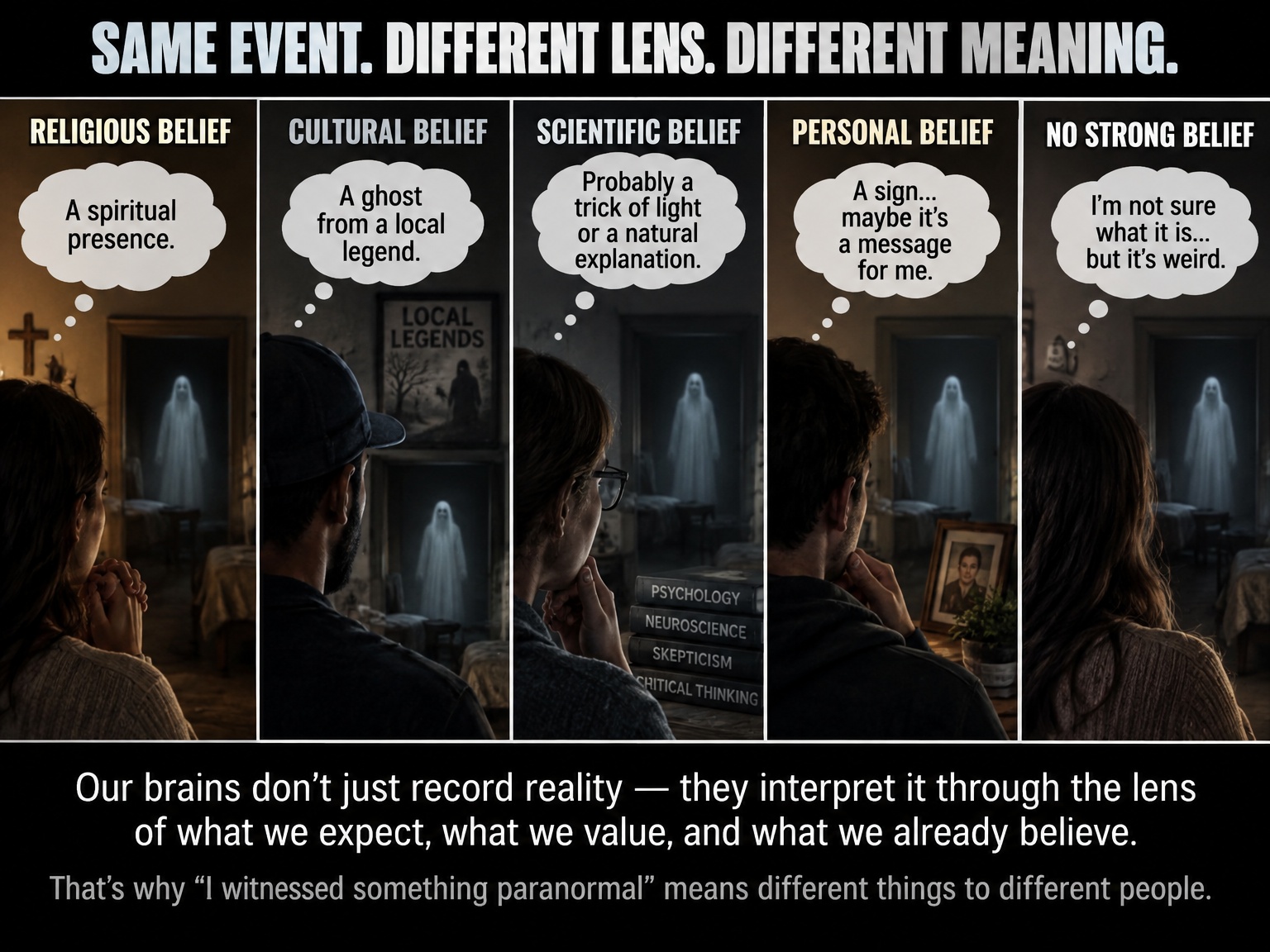
When someone says, “I witnessed something paranormal,” the claim doesn’t land in a vacuum. Our brains don’t simply record reality like cameras; they interpret experience through the lens of what we expect, what we value, and what we already believe. As a result, a belief system, religious, cultural, scientific, or personal, can strongly influence how people perceive an event, how they judge the witness, and how they decide what the experience “means.”
The mind is an interpreter, not a recorder
Perception is often assumed to be passive: something happens, the senses report it, and the facts arrive unchanged. In reality, the brain actively constructs experience. It fills in gaps, smooths uncertainty, and uses prediction to make sense of sensory input. That matters because paranormal reports typically involve ambiguity—unfamiliar sounds, strange lights, confusing sensations, or moments where the environment doesn’t clearly explain what’s being experienced.
When someone reports these kinds of experiences, belief systems can determine what feels most plausible. Two people might encounter the same kind of ambiguity and yet interpret it in completely different ways. One person may experience the event as meaningful and confirmatory, while another may experience it as an error in perception that can be explained through ordinary causes.
Belief systems act like filters
Belief systems function like interpretive filters. If you already expect paranormal phenomena, your attention may gravitate toward details that fit that expectation, and your mind may retrieve matching stories more readily. You might downplay alternative explanations or view uncertainty as evidence of something larger that can’t be fully understood.
If you lean strongly toward natural explanations, you might approach the same experience by seeking mechanisms first, environmental factors, misinterpretations, cognitive shortcuts, or psychological responses to stress. In this worldview, ambiguity becomes something to be resolved, not something to confirm. Neither stance automatically guarantees accuracy, but both shape what enters consciousness and how conclusions are formed.
The story is shaped by worldview
Paranormal experiences are rarely recounted as raw data. They are told as narratives, complete with emotion and meaning. A religious framework might interpret the event as spiritual in nature—a sign, warning, or presence. A skeptical framework may interpret it as a misunderstanding of perception. Cultural folklore may map the event onto familiar patterns of hauntings or entities. Even personal identity can play a role, connecting the experience to lifelong questions, grief, anxiety, curiosity, or prior beliefs.
Because of this, a witness can describe the same event in ways that sound consistent and compelling to one audience and confusing or untrustworthy to another. Listeners often judge credibility not only by facts, but by how well the account aligns with what they believe is possible.
Credibility often reflects agreement more than evidence
When people evaluate paranormal claims, they frequently do more than assess details. They implicitly ask whether the witness’s interpretation fits their understanding of the world, whether the claim threatens their assumptions, and whether the story aligns with their sense of what is “real.” If a witness’s interpretation matches a listener’s worldview, the story can feel more credible even when the objective information is limited. If it conflicts, the same account may feel exaggerated or suspect.
This means belief can become a stand-in for evidence. A person’s conclusion may reflect how comfortable or uncomfortable the claim is, rather than what can actually be supported.
Emotion can intensify perceived certainty
Many paranormal claims involve strong emotion. Fear, awe, and fascination can heighten attention and leave a strong impression on memory. Belief systems then interpret these emotions. Some people treat emotional intensity as confirmation that something extraordinary happened. Others interpret it as a predictable reaction to confusion, uncertainty, or stress.
Emotion doesn’t automatically mean the experience is false, but it does influence how people encode events and how they later remember them. Over time, memory can shift toward the interpretation that feels most coherent, especially when the story becomes part of a person’s identity or community.
Two people can witness the same ambiguity and disagree on reality
Consider a report of strange sounds in an empty place. One listener might decide the experience is best explained as paranormal activity. Another might decide it can be explained by ordinary environmental causes like echoes, building structure, weather, or misperception. Both interpretations can be consistent with the same basic sensory confusion: there were sounds, but the context didn’t clearly reveal their source.
The disagreement is less about whether something happened at all and more about what explanations are considered plausible, what counts as sufficient evidence, and what each worldview expects the world to contain.
Separate experience from interpretation
A healthier way to talk about paranormal claims is to distinguish between the experience itself, the interpretation placed on it, and the evidence supporting that interpretation. Belief systems often blur these layers, turning debates about meaning into debates about identity and ideology. People argue about whether the event was “real” without clarifying what was actually sensed, what reasoning led to the supernatural conclusion, and what independent support exists.
When the chain of reasoning is examined rather than just the final conclusion, belief is less likely to take over as the primary driver of judgment. This allows for both serious inquiry and respectful skepticism.
A more thoughtful approach: focus on reasoning
It’s possible to ask questions that don’t assume paranormal certainty or automatic dismissal. Asking for moment-by-moment details, clarifying sensory specifics, considering environmental factors, and evaluating consistency over time can reduce the impact of belief-driven shortcuts. Just as importantly, looking for corroboration, other witnesses, contemporaneous records, or measurable conditions, helps shift discussion from interpretation alone to what can be checked.
Even when independent evidence is limited, these steps provide a clearer picture of how the witness formed their conclusion and how others can evaluate it fairly.
Conclusion: belief doesn’t just color the story, it constructs it
A paranormal claim is not simply a report of an external event. It is the result of sensory experience interacting with memory, emotion, and the interpretive framework provided by belief. Belief systems shape what people notice, what they remember, how they explain uncertainty, and how others decide whether the witness is credible.
That doesn’t mean paranormal stories are automatically false, or automatically true. It means belief is part of the mechanism by which reality is understood and narrated. If we want better conversations about the paranormal, we need more than reflexively agreeing or rejecting. We need to examine how belief shapes perception and then evaluate claims with both care and clarity.