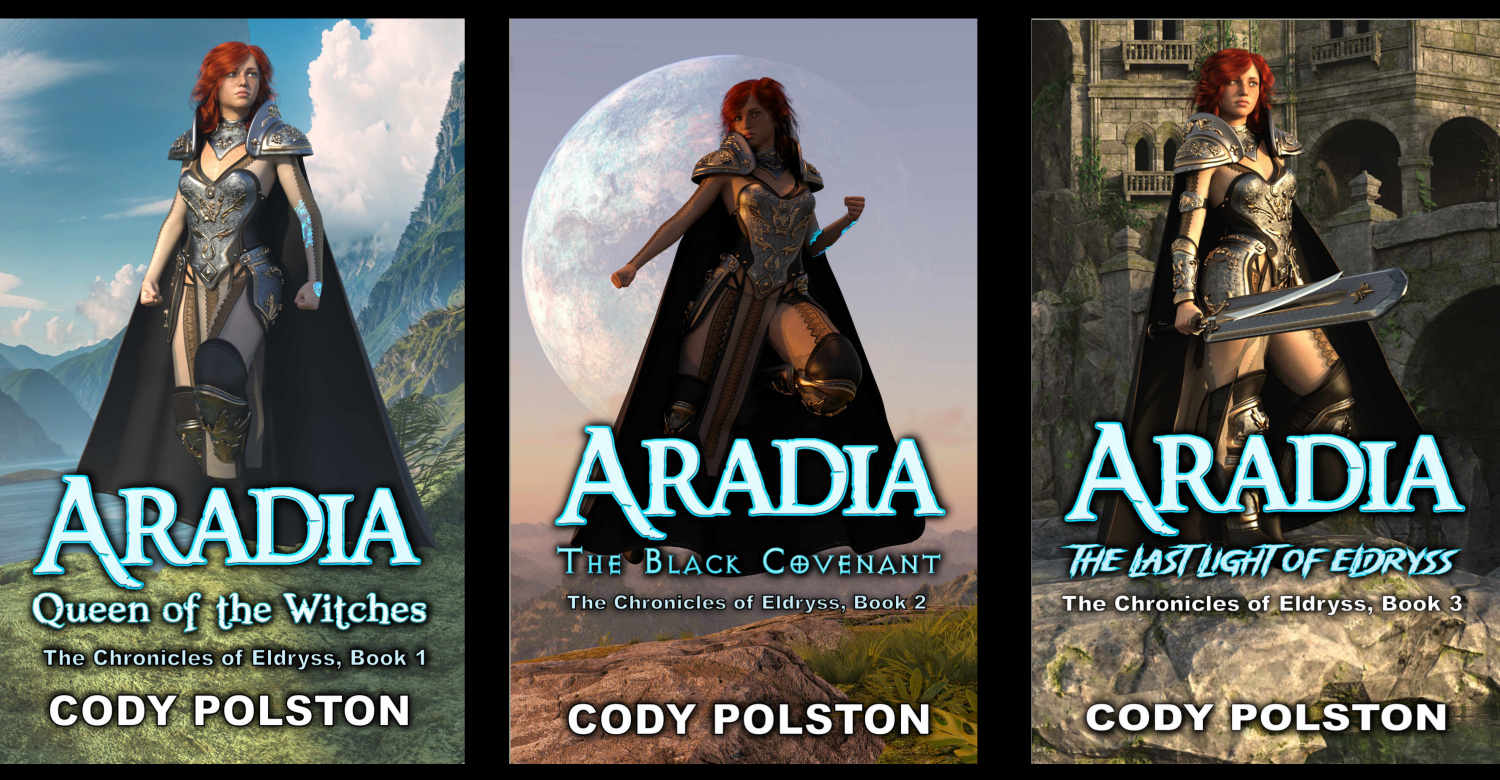
SPOILER ALERT!!!
This article contains spoilers for the series.
Epic fantasy often promises spectacle, burning cities, clashing gods, ancient evils breaking their chains. The Chronicles of Eldryss trilogy delivers all of that: sealed entities beneath cities, civil war among witches, void-rifts devouring continents, drowned capitals, and a final confrontation between a demi-goddess queen and a fallen cosmic power. Yet beneath its apocalyptic scale lies something more intimate and far more enduring: a moral inquiry into power, sovereignty, identity, and the cost of dominion.
At its heart, the Aradia saga is not simply about saving a world.
It is about refusing to rule it the wrong way. It is about rejecting seduction, not romantic seduction alone, but the seduction of control, certainty, and transcendence without accountability.
Across three books, Aradia evolves from sovereign protector to fractured ruler to integrated demi-goddess. But the moral compass of the story does not shift. It sharpens. The trilogy insists on a radical thesis for epic fantasy:
Power is not evil. But power without self-knowledge becomes annihilation. And domination, no matter how beautifully framed, is always rot.
Book I: Containment and the Ethics of Responsibility
In the first installment, Aradia inherits a throne built atop a sealed god, Vathros, the Devourer, imprisoned beneath the city of Nox Aeterna. The lattice that binds him is failing. Magic is strained. Political factions maneuver for advantage. The Sovereign’s role is not glory, it is maintenance. Containment. Endurance.
Already, the moral framework is clear: this is not a chosen-one narrative of conquest. It is a story of stewardship.
Aradia’s first major ethical challenge is not whether she can destroy Vathros. It is whether she has the right to attempt it. The ancient system, imperfect, burdensome, morally gray, has held for generations. To disrupt it risks catastrophe.
This sets the tone for the trilogy’s guiding principle: decisions must consider consequence beyond ego.
Aradia does not crave apotheosis. She does not seek expansion. She seeks stability.
That alone distinguishes her from Vathros.
Where he desires release and dominion, she values balance and protection. But Book I also plants the seeds of internal tension. The Witchblade strengthens with each use. The act of holding the Seal slowly erodes her. The throne demands sacrifice not only from enemies, but from the ruler herself.
The moral question deepens:
How much of oneself must be given to protect a world?
At what point does sacrifice become self-erasure?
Already, the series refuses simplistic binaries. Aradia is not morally pure. She makes harsh decisions. She allows violence in the name of prevention. Yet she remains anchored by a consistent north star:
Preservation over expansion.
Responsibility over glory.
Book II: Civil War and the Corruption of “Necessary” Cataclysm
The second book escalates the conflict from containment to fracture. The witches of Eldryss divide. Malverra and the Black Covenant argue that the Seal should not be preserved indefinitely. They believe evolution requires rupture. They are not cartoon villains; they are ideologues.
This is where the trilogy’s moral complexity sharpens.
Malverra’s position is dangerously persuasive. She claims that controlled awakening, binding Vathros in weakened form, would grant power. Advancement. A new age of strength.
Her philosophy echoes a recurring temptation in epic fantasy: harness the monster.
But the trilogy dismantles this logic carefully.
The civil war weakens the lattice. Each magical assault, each ritualized escalation, feeds the Devourer. The attempt to weaponize catastrophe accelerates it.
The moral compass here is not anti-change. It is anti-arrogance.
The Black Covenant’s flaw is not that they seek transformation. It is that they believe they can dominate what they do not fully understand. This is the same seduction Erebus (Vathros) uses later: partnership. Co-rule. Shared ascension.
The underlying moral warning becomes clearer:
When power is framed as “necessary,” ask who benefits.
When catastrophe is labeled “inevitable,” examine who is guiding it.
By the end of Book II, the world is cracking. But Aradia remains committed to preventing domination, even when domination promises efficiency.
Book III: Apocalypse and the Refusal of Dominion
The final book, Aradia, Last Light of Eldryss, transforms tension into total collapse. Veilborn flood into reality. Lands fall into void rifts. The Thornwild burns. Kael’Tharoth fractures. Lunareth sinks beneath black tides.
This is not war. It is unraveling.
And it is revealed that Vathros, once Erebus, has orchestrated much of the destabilization. He is not chaos incarnate. He is strategic. He manipulates factions. He feeds on conflict. He desires dominion across realms.
Here the moral opposition crystallizes:
Erebus believes that transcendence justifies subjugation.
Aradia believes that survival must not require enslavement.
The most profound layer of the trilogy emerges when Aradia regains her memory as Tesla St. Vrain, a medium, Ghostwalker, and agent of the Ministry of Psychical Research. She remembers that she is demi-goddess, daughter of Diana. She remembers killing Erebus once before.
Identity is no longer fragmented.
She is not merely queen.
Not merely goddess-blooded.
Not merely reincarnated.
She is integrated.
And this integration is crucial to the moral architecture of the story.
Integration vs Fragmentation
Many of the trilogy’s monsters reflect fragmentation. The Crown of Ashen Mirrors divides Aradia into possible selves. The Choir of Hollow Mercy weaponizes grief. The Godhusk Leviathan is divine structure without consciousness.
Erebus thrives on division. Political division. Emotional division. Identity division.
The moral core of the series asserts that fragmentation enables domination.
If Aradia rejects Tesla, she becomes incomplete.
If she rejects her goddess inheritance, she becomes vulnerable.
If she rejects her mortal empathy, she risks becoming what she fights.
Her victory does not come from becoming more powerful than Erebus in raw magnitude.
It comes from integration.
When she finally kills him, not imprisoning, not containing, but erasing, she does so as her whole self. Tesla and Aradia. Mortal discipline. Sovereign authority. Divine inheritance.
Power, aligned, not fractured.
The presence of Diana complicates the moral terrain further. As goddess of the moon and thresholds, she represents balance rather than conquest. She offers Aradia a path to seal Erebus permanently, but at a cost. The Veil would close. Magic would change. The ancient structure of Eldryss would end.
Here the trilogy poses its most difficult ethical question:
Is preserving a system worth perpetuating its inherent risk?
Aradia chooses to collapse the Veil. To end the cycle. To remove the possibility of another Erebus rising through structural vulnerability. This is not preservation. It is transformation through sacrifice, and most importantly, it is sacrifice of power.
The Witchblade becomes inert. The age of sovereign god-binding ends. Aradia does not ascend to eternal goddess-queen. She remains mortal, though forever changed.
The trilogy’s moral compass rejects the fantasy of infinite escalation.
Victory does not mean greater dominion.
It means ending the need for dominion.
The Rejection of Seduction
Erebus’s most persistent tactic is seduction, not romantic love in a conventional sense, but the seduction of inevitability. He tells Aradia she was magnificent as Tesla. That together they could rule. That she was meant for more than containment.
He frames domination as destiny. This is perhaps the most subversive moral throughline of the trilogy: destiny is not justification. Aradia’s power does not entitle her to reshape worlds for her satisfaction. Her divinity does not obligate conquest.
When she refuses Erebus’s final offer, when she rejects shared rule over merged realms, she rejects the narrative that power must culminate in supremacy.
Instead, she chooses limitation. And in doing so, she becomes stronger than any god.
The trilogy never ignores grief. The Thornwild burns. Lunareth drowns. Kael’Tharoth collapses. Loss is not undone by victory. This matters.
The moral compass does not promise restoration of everything destroyed. It promises prevention of further corruption.
Aradia’s mercy is not softness. It is measured refusal to perpetuate cycles. She does not eradicate opposition indiscriminately. She does not seize absolute control after victory. She does not rebuild Eldryss in her own image.
Instead, she stands as “Last Light”, not sole ruler, not eternal monarch, but guardian of transition. The term “last light” is telling. It suggests illumination at dusk. Witness. Passage.
She becomes threshold rather than tyrant.
The Aradia books ultimately argue five core ethical principles:
- Power requires integration. Fragmented identity invites corruption.
- Domination is not evolution. Control framed as progress is still subjugation.
- Containment without reflection becomes stagnation. Systems must change, but not through arrogance.
- Sacrifice of power is sometimes the highest form of strength.
- Love of the world must outweigh desire to rule it.
These principles distinguish the trilogy from nihilistic grimdark. While the world suffers devastation, the story does not celebrate collapse. It examines it.
Nor is it naïvely hopeful. Cities remain lost. Magic alters. The scars persist.
But Erebus is gone. Not imprisoned or deferred. Ended.
Because Aradia refuses partnership with domination, even when it promises cosmic glory.
In a genre saturated with ascension narratives, where protagonists grow ever more powerful until they eclipse gods, the Aradia trilogy offers something rarer:
De-escalation as triumph.
Integration as strength.
Limitation as wisdom.
Aradia does not become supreme deity of all realms. She becomes whole. And in a world where fracture created apocalypse, wholeness is revolutionary.
The final image of the trilogy, a scarred Eldryss beneath a whole sky, the Witchblade inert, the Veil sealed, encapsulates its moral center.
There are no eyes beneath the world anymore.
No ancient god whispering seduction from prison.
There is silence, not emptiness. Peace.
Aradia stands not as conqueror, but as witness.
She has faced apocalypse and refused dominion.
She has faced seduction and chosen responsibility.
She has faced her own fragmentation and embraced integration.
The Aradia trilogy is a story of gods and void and collapsing continents, but beneath its spectacle lies a deeply human moral truth:
The greatest power is not the ability to rule worlds. It is the refusal to rule them wrongly.
Modern discourse has intensely scrutinized leadership, its responsibilities, failures, and moral obligations. Aradia’s arc is fundamentally about ethical leadership under catastrophic pressure. She makes mistakes. She doubts. She hesitates. But she refuses to centralize power permanently, even when she could.
After defeating Erebus, she does not declare herself eternal goddess-ruler. She allows the Witchblade to fall inert. She permits the end of the old system. This choice reflects contemporary skepticism toward indefinite concentration of authority.
The trilogy’s moral stance suggests:
Leadership is temporary stewardship, not entitlement.
Victory does not justify permanent supremacy.
In a time when democratic norms and institutional integrity have been tested globally, this message resonates deeply.
Perhaps the most powerful contemporary influence on Aradia is its portrayal of refusal.
Aradia refuses seduction. Refuses domination. Refuses escalation. Refuses to preserve flawed systems without reform. In a cultural moment saturated with outrage cycles, reactionary impulses, and constant escalation, refusal becomes radical.
Refusing to mirror violence.
Refusing to centralize power permanently.
Refusing to exploit catastrophe for gain.
The trilogy argues that sometimes the most courageous act is not conquest, but restraint.
Fantasy written during turbulent times often swings toward either grimdark nihilism or escapist triumph. Aradia occupies a middle ground. It does not deny devastation. It does not promise full restoration. But it insists that moral clarity is still possible in chaos. This reflects a cultural desire not for perfect worlds, but for ethical anchors.
In uncertain times, readers seek stories that grapple with collapse honestly while still affirming agency. Aradia cannot prevent all loss. But she can choose how she wields power.
And that choice matters.